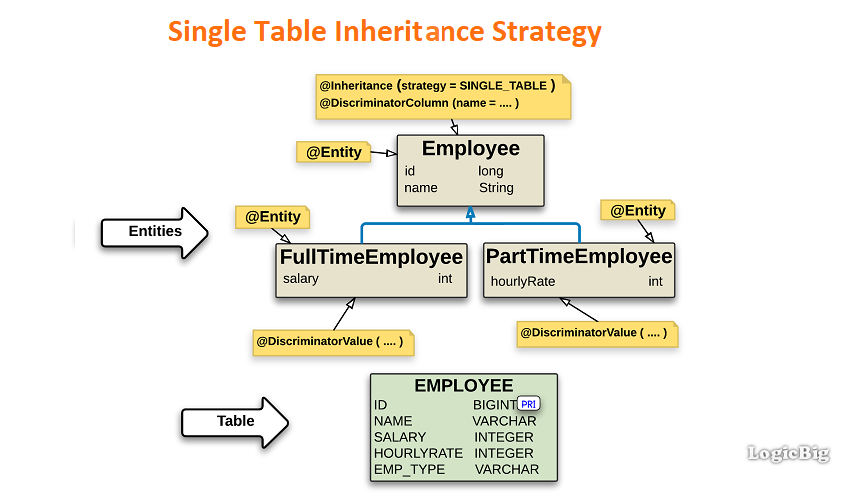
- In this strategy, all the classes in a hierarchy are mapped to a single table.
- The annotation @Inheritance is used on the root entity class with strategy =
InheritanceType.SINGLE_TABLE.
- @DiscriminatorColumn is used on the root entity class to specify the discriminator column attributes. Discriminator is a way to differentiate rows belonging to different classes in the hierarchy.
- @DiscriminatorValue is used on each persistable concrete class to specify a unique discriminator value.
- @Entity and other meta-data annotations are used on the root and subclasses as usual.
- @Id field should only be defined in the root class.
- The root class can be abstract or a concrete class. An abstract entity differs from a concrete entity only in that it cannot be directly instantiated.
- This is the default inheritance strategy. That means if we don't specify the strategy attribute of @Inheritance annotation on the the root class or don't use this annotation at all , then InheritanceType.SINGLE_TABLE strategy is assumed.
- This strategy has the disadvantage of having rows with null column values for which the entity has no corresponding fields.
Example
@Inheritance(strategy = InheritanceType.SINGLE_TABLE)
@Entity
@DiscriminatorColumn(name = "EMP_TYPE")
public class Employee {
    @Id
    @GeneratedValue
    private long id;
    private String name;
    .............
}
@Entity
@DiscriminatorValue("F")
public class FullTimeEmployee extends Employee {
    private int salary;
    .............
}
@Entity
@DiscriminatorValue("P")
public class PartTimeEmployee extends Employee {
    private int hourlyRate;
    .............
}
public class ExampleMain {

    public static void main(String[] args) {
        EntityManagerFactory emf =
                Persistence.createEntityManagerFactory("example-unit");
        try {
            EntityManager em = emf.createEntityManager();
            nativeQuery(em, "SHOW TABLES");
            nativeQuery(em, "SHOW COLUMNS from EMPLOYEE");

        } finally {
            emf.close();
        }
    }

    public static void nativeQuery(EntityManager em, String s) {
        System.out.printf("'%s'%n", s);
        Query query = em.createNativeQuery(s);
        List list = query.getResultList();
        for (Object o : list) {
            if (o instanceof Object[]) {
                System.out.println(Arrays.toString((Object[]) o));
            } else {
                System.out.println(o);
            }
        }
    }
}
'SHOW TABLES'
[EMPLOYEE, PUBLIC]
'SHOW COLUMNS from EMPLOYEE'
[EMP_TYPE, VARCHAR(31), NO, , NULL]
[ID, BIGINT(19), NO, PRI, NULL]
[NAME, VARCHAR(255), YES, , NULL]
[HOURLYRATE, INTEGER(10), YES, , NULL]
[SALARY, INTEGER(10), YES, , NULL]
A quick overview:
Persisting and loading data
public class ExampleMain2 {

    public static void main(String[] args) throws Exception {
        EntityManagerFactory emf =
                Persistence.createEntityManagerFactory("example-unit");
        try {
            persistEntities(emf);
            runNativeQueries(emf);
            loadEntities(emf);
        } finally {
            emf.close();
        }
    }

    private static void persistEntities(EntityManagerFactory emf) throws Exception {
        System.out.println("-- Persisting entities --");
        EntityManager em = emf.createEntityManager();

        FullTimeEmployee e1 = new FullTimeEmployee();
        e1.setName("Sara");
        e1.setSalary(100000);
        System.out.println(e1);

        PartTimeEmployee e2 = new PartTimeEmployee();
        e2.setName("Tom");
        e2.setHourlyRate(60);
        System.out.println(e2);

        em.getTransaction().begin();
        em.persist(e1);
        em.persist(e2);
        em.getTransaction().commit();
        em.close();
    }

    private static void runNativeQueries(EntityManagerFactory emf) {
        System.out.println("-- Native queries --");
        EntityManager em = emf.createEntityManager();
        ExampleMain.nativeQuery(em, "Select * from Employee");
    }

    private static void loadEntities(EntityManagerFactory emf) {
        System.out.println("-- Loading entities --");
        EntityManager em = emf.createEntityManager();
        List<Employee> entityAList = em.createQuery("Select t from Employee t")
                                       .getResultList();
        entityAList.forEach(System.out::println);
        em.close();
    }
}
-- Persisting entities --
FullTimeEmployee{id=0, name='Sara', salary=100000}
PartTimeEmployee{id=0, name='Tom', hourlyRate='60'}
-- Native queries --
'Select * from Employee'
[F, 1, Sara, null, 100000]
[P, 2, Tom, 60, null]
-- Loading entities --
FullTimeEmployee{id=1, name='Sara', salary=100000}
PartTimeEmployee{id=2, name='Tom', hourlyRate='60'}
Example ProjectDependencies and Technologies Used: - h2 1.4.196: H2 Database Engine.
- hibernate-core 5.2.10.Final: The core O/RM functionality as provided by Hibernate.
Implements javax.persistence:javax.persistence-api version 2.1 - JDK 1.8
- Maven 3.3.9
|
|