This example will show how to map a java.util.Map having entity keys and entity values.
As we have already learnt in previous tutorials, to map entity values, we need to use @OneToMany/@ManyToMany and to map entity keys, we need to use @ElementCollection. This example is simply a combination of the two cases.
@OneToMany Example
@Entity
public class Employee {
    @Id
    @GeneratedValue
    private long id;
    private String name;
    @ElementCollection
    @OneToMany
    private Map<AssignInfo, Task> taskMap;
    .............
}
@Entity
public class AssignInfo {
    @Id
    @GeneratedValue
    private long id;
    private Date startDate;
    private Date endDate;
    .............
}
@Entity
public class Task {
    @Id
    @GeneratedValue
    private long id;
    private String name;
    private String description;
    .............
}
Note that using both @OneToMany and @ElementCollection together is redundant. Hibernate can recognise the intended mapping, if we use just one of them.
public class ExampleMain {

    public static void main(String[] args) {
        EntityManagerFactory emf =
                Persistence.createEntityManagerFactory("example-unit");
        try {
            EntityManager em = emf.createEntityManager();
            nativeQuery(em, "SHOW TABLES");
            nativeQuery(em, "SHOW COLUMNS from EMPLOYEE");
            nativeQuery(em, "SHOW COLUMNS from TASK");
            nativeQuery(em, "SHOW COLUMNS from EMPLOYEE_TASK");
            nativeQuery(em, "SHOW COLUMNS from ASSIGNINFO");
        } finally {
            emf.close();
        }
    }
    .............
}Output'SHOW TABLES'
[ASSIGNINFO, PUBLIC]
[EMPLOYEE, PUBLIC]
[EMPLOYEE_TASK, PUBLIC]
[TASK, PUBLIC]
'SHOW COLUMNS from EMPLOYEE'
[ID, BIGINT(19), NO, PRI, NULL]
[NAME, VARCHAR(255), YES, , NULL]
'SHOW COLUMNS from TASK'
[ID, BIGINT(19), NO, PRI, NULL]
[DESCRIPTION, VARCHAR(255), YES, , NULL]
[NAME, VARCHAR(255), YES, , NULL]
'SHOW COLUMNS from EMPLOYEE_TASK'
[EMPLOYEE_ID, BIGINT(19), NO, PRI, NULL]
[TASKMAP_ID, BIGINT(19), NO, UNI, NULL]
[TASKMAP_KEY, BIGINT(19), NO, PRI, NULL]
'SHOW COLUMNS from ASSIGNINFO'
[ID, BIGINT(19), NO, PRI, NULL]
[ENDDATE, TIMESTAMP(23), YES, , NULL]
[STARTDATE, TIMESTAMP(23), YES, , NULL]
H2 database SHOW statements
A quick overview of the mapping:
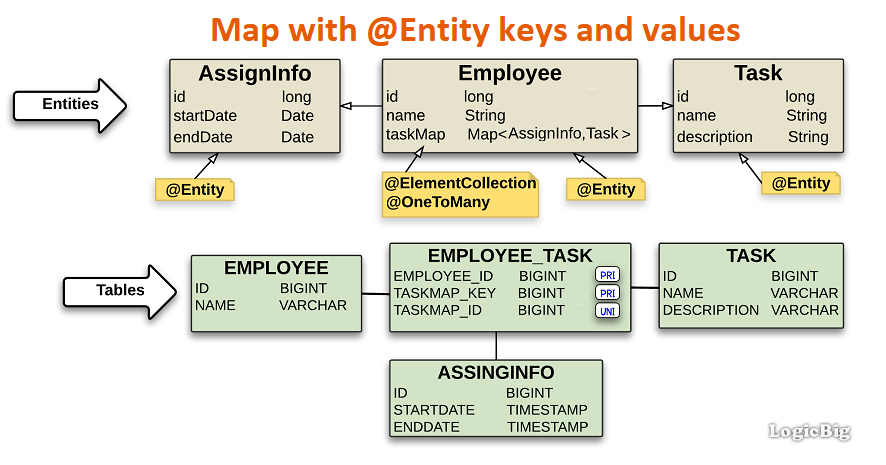
In the join table (EMPLOYEE_TASK) the foreign key pointing to the map value's primary key (TASK table in above example) is unique. That's because it's a OneToMany relation, which does not allow to share the same target entity. If we use @ManyToMany, then there won't be any unique constraint.
Complete Example
Persisting and loading data
public class ExampleMain2 {

    public static void main(String[] args) throws Exception {
        EntityManagerFactory emf =
                Persistence.createEntityManagerFactory("example-unit");
        try {
            persistEntity(emf);
            runNativeQueries(emf);
            loadEntity(emf);
        } finally {
            emf.close();
        }
    }

    private static void persistEntity(EntityManagerFactory emf) throws Exception {
        System.out.println("-- Persisting entities --");
        EntityManager em = emf.createEntityManager();

        SimpleDateFormat sdf = new SimpleDateFormat("MM-dd-yy");

        Employee e1 = new Employee();
        e1.setName("employee name 1");
        Task task1 = new Task();
        task1.setName("task 1");
        task1.setDescription("task 1 desc");
        AssignInfo assignInfo1 = new AssignInfo();
        assignInfo1.setStartDate(sdf.parse("15-01-17"));
        assignInfo1.setEndDate(sdf.parse("20-01-17"));
        e1.addTask( assignInfo1, task1);
        Task task2 = new Task();
        task2.setName("task 2");
        task2.setDescription("task 2 desc");
        AssignInfo assignInfo2 = new AssignInfo();
        assignInfo2.setStartDate(sdf.parse("02-01-17"));
        assignInfo2.setEndDate(sdf.parse("11-02-17"));
        e1.addTask(assignInfo2, task2);
        System.out.println(e1);

        Employee e2 = new Employee();
        e2.setName("employee name 2");
        Task task3 = new Task();
        task3.setName("task 3");
        task3.setDescription("task 3 desc");
        AssignInfo assignInfo3 = new AssignInfo();
        assignInfo3.setStartDate(sdf.parse("9-02-17"));
        assignInfo3.setEndDate(sdf.parse("19-03-17"));
        e2.addTask(assignInfo3, task3);
        System.out.println(e2);

        em.getTransaction().begin();
        em.persist(task1);
        em.persist(task2);
        em.persist(task3);
        em.persist(assignInfo1);
        em.persist(assignInfo2);
        em.persist(assignInfo3);
        em.persist(e1);
        em.persist(e2);
        em.getTransaction().commit();
        em.close();
    }

    private static void runNativeQueries(EntityManagerFactory emf) {
        System.out.println("-- Native queries --");
        EntityManager em = emf.createEntityManager();
        ExampleMain.nativeQuery(em, "Select * from Employee");
        ExampleMain.nativeQuery(em, "Select * from Task");
        ExampleMain.nativeQuery(em, "Select * from Employee_Task");
        ExampleMain.nativeQuery(em, "Select * from AssignInfo");
    }

    private static void loadEntity(EntityManagerFactory emf) {
        System.out.println("-- Loading entities --");
        EntityManager em = emf.createEntityManager();
        List<Employee> entityAList = em.createQuery("Select t from Employee t")
                                       .getResultList();
        entityAList.forEach(System.out::println);
        em.close();
    }
}Output-- Persisting entities --
Employee{id=0, name='employee name 1', taskMap={AssignInfo{id=0, startDate=Thu Mar 01 00:00:00 CST 2018, endDate=Wed Aug 01 00:00:00 CST 2018}=Task{id=0, name='task 2', description='task 2 desc'}}}
Employee{id=0, name='employee name 2', taskMap={AssignInfo{id=0, startDate=Sat Sep 02 00:00:00 CST 2017, endDate=Tue Jul 03 00:00:00 CST 2018}=Task{id=0, name='task 3', description='task 3 desc'}}}
-- Native queries --
'Select * from Employee'
[7, employee name 1]
[8, employee name 2]
'Select * from Task'
[1, task 1 desc, task 1]
[2, task 2 desc, task 2]
[3, task 3 desc, task 3]
'Select * from Employee_Task'
[7, 2, 4]
[8, 3, 6]
'Select * from AssignInfo'
[4, 2018-08-01 00:00:00.0, 2018-03-01 00:00:00.0]
[5, 2017-11-02 00:00:00.0, 2017-02-01 00:00:00.0]
[6, 2018-07-03 00:00:00.0, 2017-09-02 00:00:00.0]
-- Loading entities --
Employee{id=7, name='employee name 1', taskMap={AssignInfo{id=4, startDate=2018-03-01 00:00:00.0, endDate=2018-08-01 00:00:00.0}=Task{id=2, name='task 2', description='task 2 desc'}}}
Employee{id=8, name='employee name 2', taskMap={AssignInfo{id=6, startDate=2017-09-02 00:00:00.0, endDate=2018-07-03 00:00:00.0}=Task{id=3, name='task 3', description='task 3 desc'}}}
Example ProjectDependencies and Technologies Used: - h2 1.4.195: H2 Database Engine.
- hibernate-core 5.2.10.Final: The core O/RM functionality as provided by Hibernate.
Implements javax.persistence:javax.persistence-api version 2.1 - JDK 1.8
- Maven 3.3.9
|
|