This example demonstrates how to use Apache FreeMarker templates as the view technology in a Spring MVC application.
Example
Maven dependencies
pom.xml<dependency>
<groupId>org.freemarker</groupId>
<artifactId>freemarker</artifactId>
<version>2.3.35</version>
</dependency>
<dependency>
<groupId>org.springframework</groupId>
<artifactId>spring-context-support</artifactId>
<version>7.0.6</version>
</dependency>
spring-context-support contains Spring's base FreeMarker support classes (for example, FreeMarkerConfigurationFactory, which FreeMarkerConfigurer extends). The same module also provides integration with other common third-party libraries, such as Quartz, Jakarta Mail and caching providers.
Java Config class
package com.logicbig.example;

import org.springframework.context.annotation.Bean;
import org.springframework.context.annotation.ComponentScan;
import org.springframework.context.annotation.Configuration;
import org.springframework.web.servlet.ViewResolver;
import org.springframework.web.servlet.config.annotation.EnableWebMvc;
import org.springframework.web.servlet.config.annotation.ViewResolverRegistry;
import org.springframework.web.servlet.config.annotation.WebMvcConfigurer;
import org.springframework.web.servlet.config.annotation.ViewResolverRegistry;
import org.springframework.web.servlet.view.freemarker.FreeMarkerConfigurer;
import org.springframework.web.servlet.view.freemarker.FreeMarkerViewResolver;

@EnableWebMvc
@Configuration
@ComponentScan
public class MyWebConfig implements WebMvcConfigurer {

    @Override
    public void configureViewResolvers (ViewResolverRegistry registry) {
        registry.freeMarker();
    }

    @Bean
    public FreeMarkerConfigurer freeMarkerConfigurer() {
        FreeMarkerConfigurer configurer =
                new FreeMarkerConfigurer();
        configurer.setTemplateLoaderPath("/WEB-INF/views/");
        return configurer;
    }
}
Writing a Spring Controller
package com.logicbig.example;

import org.springframework.stereotype.Controller;
import org.springframework.ui.Model;
import org.springframework.web.bind.annotation.RequestMapping;
import java.time.LocalTime;

@Controller
@RequestMapping("/")
public class MyController {

    @RequestMapping
    public String handleRequest(Model model) {
        model.addAttribute("msg",
                           "A message from the controller");
        model.addAttribute("time", LocalTime.now());
        return "my-page";
    }
}
The FreeMarker template
src/main/webapp/WEB-INF/views/my-page.ftl<!DOCTYPE html>
<html lang="en">
<body>
<h2>FreeMarker View</h2>
<div> Message: ${msg}</div>
<div> Time: ${time} </div>
</body>
</html>
This diagram shows how freemarker works with Spring:
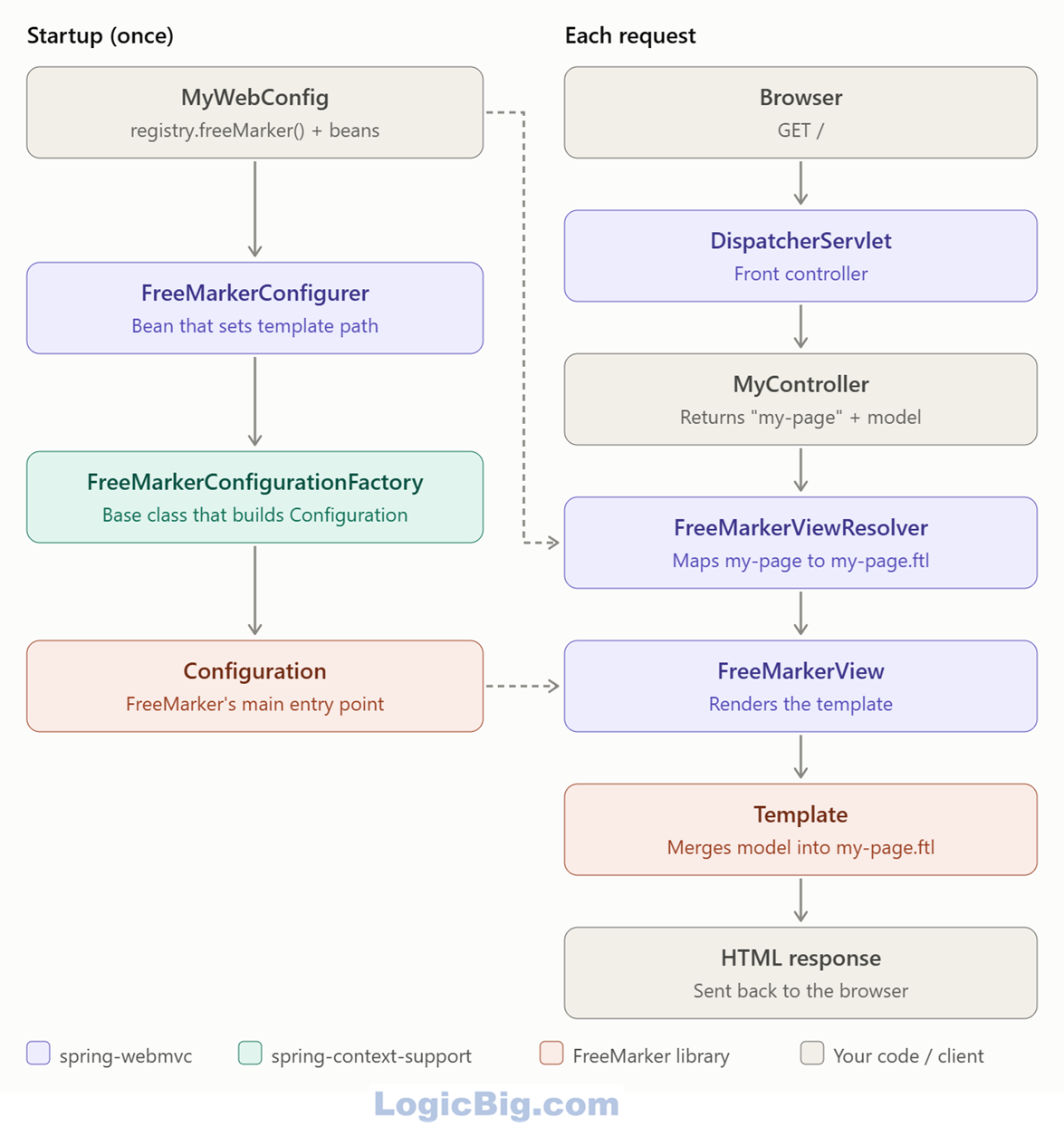
More information about the FreeMarker template engine can be found here.
Running the example
To try examples, run embedded Jetty (configured in pom.xml of example project below):
mvn jetty:run Output
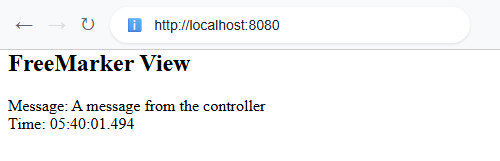 $ curl -s "http://localhost:8080"
<!DOCTYPE html>
<html lang="en">
<body>
<h2>FreeMarker View</h2>
<div> Message: A message from the controller</div>
<div> Time: 05:40:01.494 </div>
</body>
</html>
Example ProjectDependencies and Technologies Used: - spring-webmvc 7.0.6 (Spring Web MVC)
Version Compatibility: 4.1.0.RELEASE - 7.0.6 Version compatibilities of spring-webmvc with this example: Versions in green have been tested.
- spring-context-support 7.0.6 (Spring Context Support)
- freemarker 2.3.35 (FreeMarker is a "template engine"; a generic tool to generate text output based on templates)
- jakarta.servlet-api 6.1.0 (Jakarta Servlet API documentation)
- JDK 25
- Maven 3.9.11
|