- By default, a unidirectional one-to-many association uses an intermediate join table to store the relationship. This default mapping is also referred as 'one-to-many join table mapping strategy'.
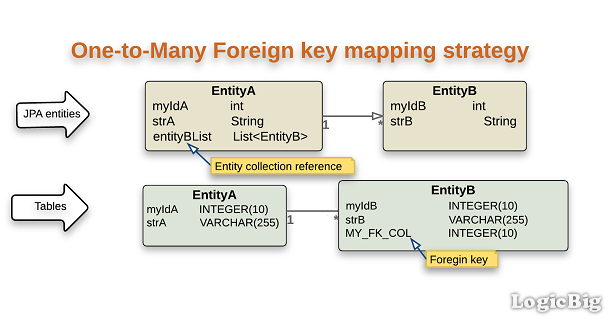
- In 'one-to-many foreign key mapping strategy', instead of using a join table, we use a foreign key column in the 'target' table. This foreign key column stores the references of primary keys from the 'source' table.
- To use this strategy we have to use @JoinColumn annotation along with @OneToMany in the source entity.
Example
@Entity
public class EntityA {
    @Id
    @GeneratedValue
    private int myIdA;
    private String strA;
    @OneToMany
    @JoinColumn(name = "MY_FK_COL")
    private List<EntityB> entityBList;
    .............
}
@Entity
public class EntityB {
    @Id
    @GeneratedValue
    private int myIdB;
    private String strB;
    .............
}
public class ExampleMain {

    public static void main(String[] args) {
        EntityManagerFactory emf = Persistence.createEntityManagerFactory("test1");
        try {
            EntityManager em = emf.createEntityManager();
            nativeQuery(em, "SHOW TABLES");
            nativeQuery(em, "SHOW COLUMNS from EntityA");
            nativeQuery(em, "SHOW COLUMNS from EntityB");
            emf.close();
        } finally {
            emf.close();
        }
    }

    public static void nativeQuery(EntityManager em, String s) {
        System.out.printf("--------%n'%s'%n", s);
        Query query = em.createNativeQuery(s);
        List list = query.getResultList();
        for (Object o : list) {
            if (o instanceof Object[]) {
                System.out.println(Arrays.toString((Object[]) o));
            } else {
                System.out.println(o);
            }
        }
    }
}Output--------
'SHOW TABLES'
[ENTITYA, PUBLIC]
[ENTITYB, PUBLIC]
--------
'SHOW COLUMNS from EntityA'
[MYIDA, INTEGER(10), NO, PRI, NULL]
[STRA, VARCHAR(255), YES, , NULL]
--------
'SHOW COLUMNS from EntityB'
[MYIDB, INTEGER(10), NO, PRI, NULL]
[STRB, VARCHAR(255), YES, , NULL]
[MY_FK_COL, INTEGER(10), YES, , NULL]
H2 database SHOW statements
The above output shows that no 'join table' is generated, instead a foreign-key column, MY_FK_COL has been used to persist the relationship. If we don't specify 'name' element of @JoinColumn, the default ENTITYBLIST_MYIDA will be used.
Following diagram gives a quick overview of the relationship
Let's persist some data.
public class ExampleMain2 {

    public static void main(String[] args) {
        EntityManagerFactory emf = Persistence.createEntityManagerFactory("test1");
        try {
            persistEntity(emf);
            nativeQueries(emf);
            loadEntityA(emf);
            loadEntityB(emf);
        } finally {
            emf.close();
        }
    }

    private static void nativeQueries(EntityManagerFactory emf) {
        System.out.println("-- native queries --");
        EntityManager em = emf.createEntityManager();
        ExampleMain.nativeQuery(em, "Select * from EntityA");
        ExampleMain.nativeQuery(em, "Select * from EntityB");
    }

    private static void persistEntity(EntityManagerFactory emf) {
        EntityManager em = emf.createEntityManager();

        EntityB entityB = new EntityB();
        entityB.setStrB("testStringB");

        EntityB entityB2 = new EntityB();
        entityB2.setStrB("testStringB2");

        EntityA entityA = new EntityA();
        entityA.setStrA("testStringA");
        entityA.setEntityBList(Arrays.asList(entityB, entityB2));

        System.out.println("-- Persisting entities --");
        System.out.println(entityA);

        em.getTransaction().begin();
        em.persist(entityA);
        em.persist(entityB);
        em.persist(entityB2);
        em.getTransaction().commit();

        em.close();
    }

    private static void loadEntityA(EntityManagerFactory emf) {
        System.out.println("-- Loading EntityA --");
        EntityManager em = emf.createEntityManager();
        List<EntityA> entityAList = em.createQuery("Select t from EntityA t").getResultList();
        entityAList.forEach(System.out::println);
        em.close();
    }

    private static void loadEntityB(EntityManagerFactory emf) {
        System.out.println("-- Loading EntityB --");
        EntityManager em = emf.createEntityManager();
        List<EntityB> entityBList = em.createQuery("Select t from EntityB t").getResultList();
        entityBList.forEach(System.out::println);
        em.close();
    }
}Output-- Persisting entities --
EntityA{myIdA=0, entityBList=[EntityB{myIdB=0, strB='testStringB'}, EntityB{myIdB=0, strB='testStringB2'}], strA='testStringA'}
-- native queries --
--------
'Select * from EntityA'
[1, testStringA]
--------
'Select * from EntityB'
[2, testStringB, 1]
[3, testStringB2, 1]
-- Loading EntityA --
EntityA{myIdA=1, entityBList=[EntityB{myIdB=2, strB='testStringB'}, EntityB{myIdB=3, strB='testStringB2'}], strA='testStringA'}
-- Loading EntityB --
EntityB{myIdB=2, strB='testStringB'}
EntityB{myIdB=3, strB='testStringB2'}
Example ProjectDependencies and Technologies Used: - h2 1.4.193: H2 Database Engine.
- hibernate-core 5.2.8.Final: The core O/RM functionality as provided by Hibernate.
Implements javax.persistence:javax.persistence-api version 2.1 - JDK 1.8
- Maven 3.3.9
|
|