In the following example we are going to show how to implement authentication using HandlerInterceptor. If the clients want to access a page without logged in, the request is redirected to the login page.
Note that for production-grade authentication, authorization, or CSRF protection, you should use Spring Security — not interceptors.
Interceptors are best kept for cross-cutting technical concerns such as request logging, performance monitoring, setting common model attributes, or measuring execution time. They are not a security layer.
Example
package com.logicbig.example;

import org.springframework.web.bind.annotation.RequestMapping;
import org.springframework.web.method.HandlerMethod;
import org.springframework.web.servlet.handler.HandlerInterceptorAdapter;
import javax.servlet.http.HttpServletRequest;
import javax.servlet.http.HttpServletResponse;

public class LoginInterceptor extends HandlerInterceptorAdapter {
    @Override
    public boolean preHandle(HttpServletRequest request,
                             HttpServletResponse response,
                             Object handler) throws Exception {

        RequestMapping rm = ((HandlerMethod) handler).getMethodAnnotation(
                RequestMapping.class);

        boolean alreadyLoggedIn = request.getSession()
                                         .getAttribute("user") != null;
        boolean loginPageRequested = rm != null &&
                rm.value().length > 0 &&
                "login".equals(rm.value()[0]);

        if (alreadyLoggedIn && loginPageRequested) {
            response.sendRedirect(request.getContextPath() + "/app/main-page");
            return false;
        } else if (!alreadyLoggedIn && !loginPageRequested) {
            response.sendRedirect(request.getContextPath() + "/login");
            return false;
        }

        return true;
    }
}
package com.logicbig.example;

import org.springframework.beans.factory.annotation.Autowired;
import org.springframework.stereotype.Controller;
import org.springframework.ui.Model;
import org.springframework.web.bind.annotation.RequestMapping;
import org.springframework.web.bind.annotation.RequestMethod;

import javax.servlet.http.HttpServletRequest;

@Controller
public class AppController {

    @Autowired
    private UserService userService;

    @RequestMapping(value = "login", method = RequestMethod.GET)
    public String handleLoginGetRequest () {
        return "user-login";
    }

    @RequestMapping(value = "login", method = RequestMethod.POST)
    public String handleLoginPostRequest (User user, Model model,
                                          HttpServletRequest request) {

        User loggedUser = userService.loginUser(user);
        if (loggedUser != null) {
            request.getSession(true)
                   .setAttribute("user", loggedUser);
            return "redirect:/app/main-page";
        } else {
            model.addAttribute("error", "Not a valid user");
            return "user-login";
        }
    }

    @RequestMapping(value = "app/**", method = RequestMethod.GET)
    public String handleAppRequest (Model model, HttpServletRequest request) {
        model.addAttribute("uri", request.getRequestURI());
        model.addAttribute("user", request.getAttribute("user"));
        return "app-page";
    }
}
Running example
To try examples, run embedded Jetty (configured in pom.xml of example project below):
mvn jetty:run 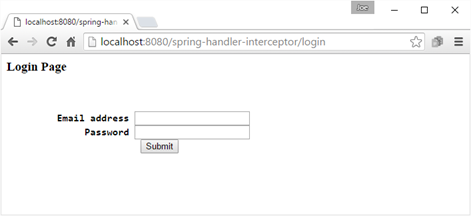
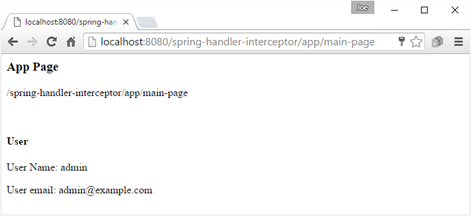
Enter 'admin@example.com' for email address and 'password' for password:
Example ProjectDependencies and Technologies Used: - spring-webmvc 4.2.4.RELEASE (Spring Web MVC)
- spring-test 4.2.4.RELEASE (Spring TestContext Framework)
- javax.servlet-api 3.0.1 (Java Servlet API)
- junit 4.12 (JUnit is a unit testing framework for Java, created by Erich Gamma and Kent Beck)
- JDK 1.8
- Maven 3.9.11
|